A results page for everyone who enters
Leep Audio is a Canadian music platform where independent artists upload tracks, remix each other's songs and look for collaborators. Competitions are one of its main features: artists remix a track or submit a song, and a jury or a public vote picks the winners. Leep wants to run many kinds of competitions, so the experience needed an engine that adapts to each type, instead of a separate design for every format. I designed that system and went deepest on two moments: finding a competition, and finding out how it went. After a competition, an artist needs a reason to come back to Leep and enter again, and the results page is where that reason has to appear.
Find a competition you can still enter
Know what is asked and how winners are chosen
Follow the competition, listen to the other entries and vote
See the winners, your rank and how your track did
Leep's competitions had never been mapped from start to finish
Two Designlab teams had worked with Leep before us. They left research and a full competition concept with a live leaderboard. Leep liked the interface but did not ship it, because it leaned too far into gaming. The live beta did not match what the earlier teams had designed, so the starting point was complex: ideas from different sources were mixed together, and part of my job was to sort out what to keep.
The brief for my stream asked one question:
How does an artist enter a competition, take part, get judged and come out the other side?
The artist to design for was the emerging artist who arrives with almost no audience. Leep also stands against pay-to-play, where paying improves your chances of winning. Paid plans can improve an artist's tools, and results still have to feel earned.
I ran three interviews with Leep's team to understand how competitions work today and where the company wants to take them. They confirmed that Leep wants many kinds of competitions, for example a giveaway, one judged by a jury, one decided by public vote and one with brackets, that each format has its own rules, and that producers and brands could run their own competitions later. The earlier Designlab teams had left research and screens, so I built on their work instead of starting over.
Leep also shared written feedback from six beta testers, which pointed to connection as part of the answer, beyond the competition itself.
After a loss, the beta showed nothing
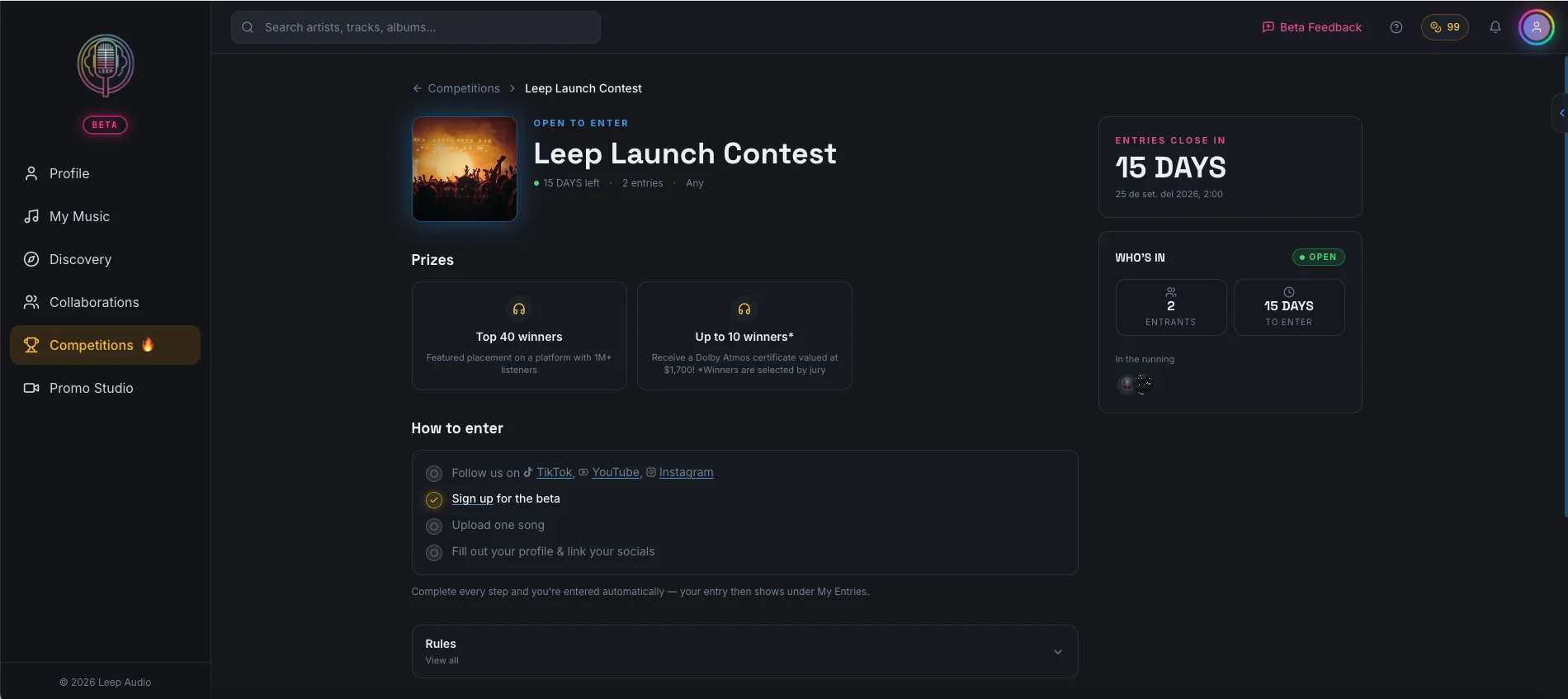
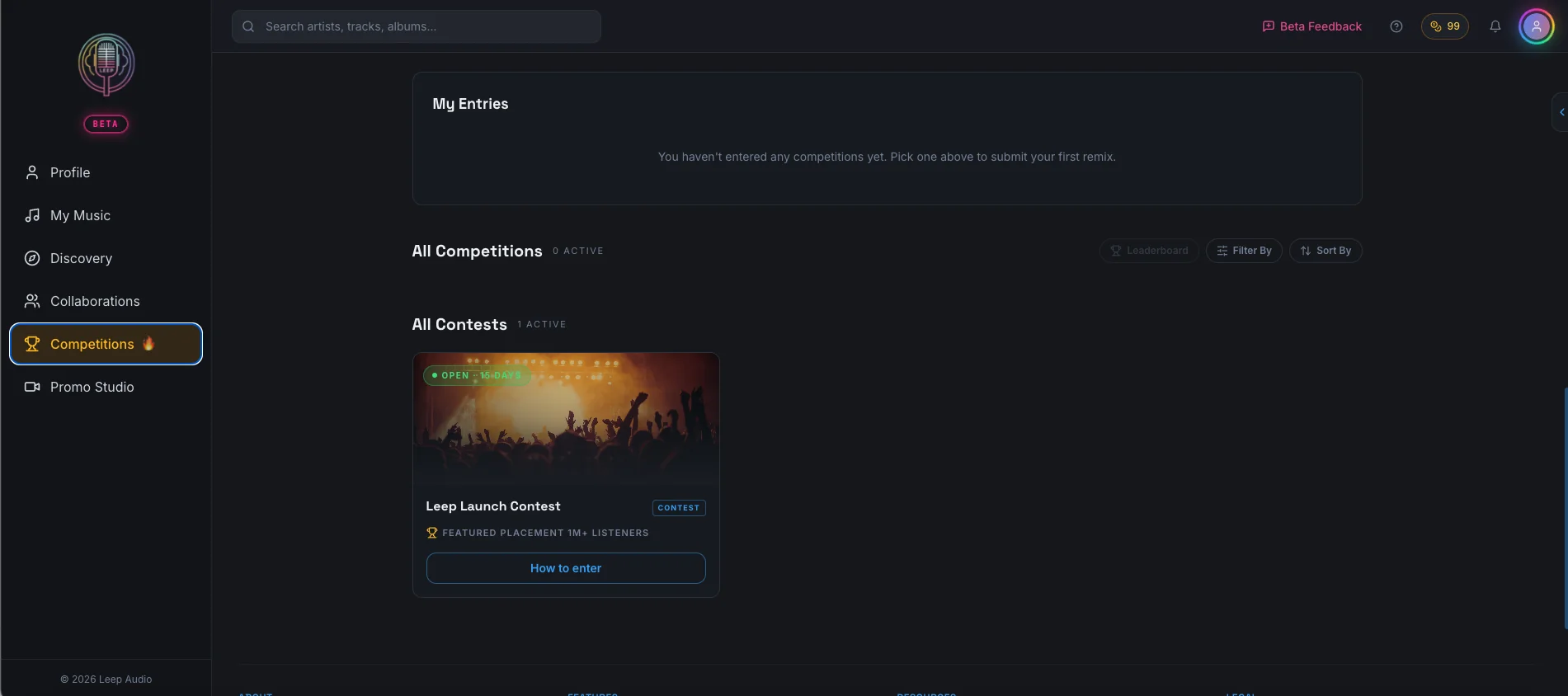
I walked through the live beta as an artist and wrote down 12 problems in three groups. These are the main ones:
Entering
The beta used two names, Competitions and Contests.
The steps to enter mixed real requirements with growth tasks, like following Leep on social media.
There was no direct button to enter a song.
After entering
There was no state while waiting for the deadline and no results state at the end.
Leaderboard, Filter and Sort were already on the screen, greyed out.
Trust
The page said "Winners are selected by jury", with no criteria.
Entrants could not see or listen to who else had entered.
Jayla has a few songs and not much traction yet
Leep's own persona for its emerging artist is Jayla, a 21-year-old vocalist and rapper who has released a few songs without much traction. Leep treats its personas as hypotheses, so I used her as a starting point. For Jayla, a competition may be a first real step on Leep, and a loss with nothing after it gives her little reason to try again.
Posting music can feel like shouting into the void.
Most entrants lose
The brief pointed it out early: only a few people win each competition. So the experience of losing could influence whether people come back.
"Only 3 of 142 entries win."
Takeaway: what comes after the result could influence whether artists enter again.
What if losing still left you with something?
I turned the problem into one question. Four ideas anchored the answer: visibility, progress, connection and a reason to try again.
design what happens during and after a competition, so that entering, even without winning, still leaves someone with something real?
Three decisions that shaped the competitions
Each decision started from the client meetings, the beta teardown or what I saw in testing.
One system for every competition type
A separate design for each format
ConsideredOne system with settings Leep can combine
✓ My choice- In the client meetings, Leep confirmed four formats: a Giveaway, decided by a random draw, and three kinds of competition, decided by jury, by public vote or by brackets. "Contest" was not a real format of its own.
- I compared the four on how you enter, how winners are chosen, how rounds work and what happens after. Every format had the same building blocks: judging, rounds, who can see other entries, prizes and what happens after.
- Four separate builds would be hard to maintain.
One system also opens a direction the client wanted: producers and brands running their own competitions later.
Depth for two formats. The Giveaway and the bracket follow the same system, but there was no time to design them in detail.
In the final presentation, Leep liked how the design handled the different competition types.
With four weeks, I went deep on the start and the end
Every format and every step at the same depth
ConsideredTwo moments in depth: finding a competition, and the results
✓ My choice- Designing every format at the same depth in four weeks was not realistic.
- The beta failed most at the start and at the end: two names for one thing and no direct button to enter, and nothing to see after a loss.
- Most entrants lose, so the results page is where a reason to come back has to appear.
Leep had not set a fixed scope. I raised it in our weekly meetings, and they agreed to limit the work to these two moments.
The middle, the competition page, the entries and the voting, builds on the earlier team's screens.
Winners and your own result on one page, winners first
Winners and your Playback on separate pages
ConsideredOne page, your own result first
ConsideredOne page, winners first
✓ My choice- The earlier team had the winners and the Recap on separate pages. At the team stand-up, the feedback was to merge them.
- The tester mentioned that her own rank could come first, but said she would not really change the order, so the winners stayed on top.
- Your rank also appears in the final leaderboard, so you see yourself next to the top five.
The personal result sits lower on the page, so artists scroll to reach it.
One moderated session and a survey with 8 answers: a first signal, not proof.
Leep liked the Playback, and that the results page leads to other competitions and collaborations, a reason to stay on the platform.
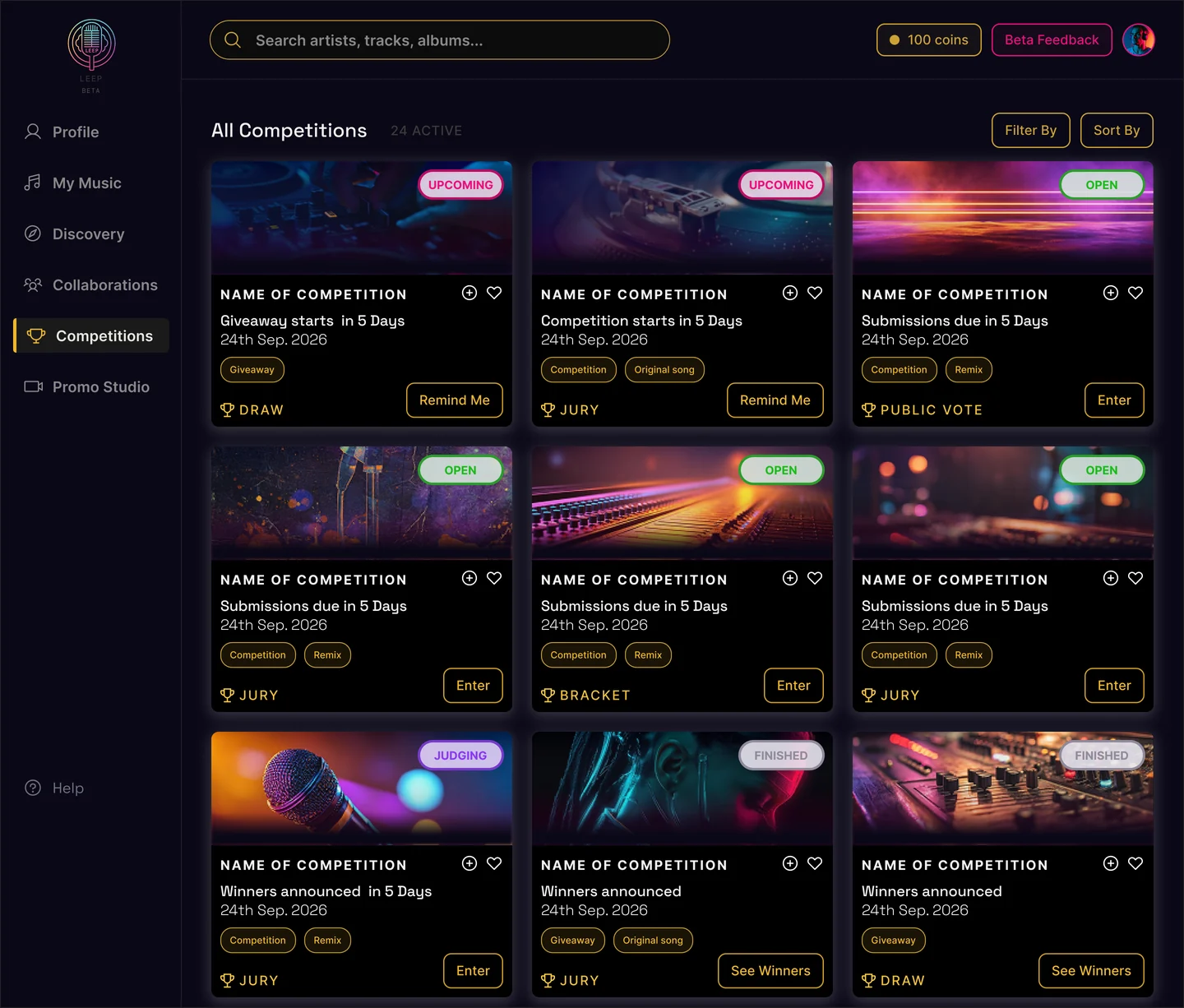
Telling competitions apart at a glance
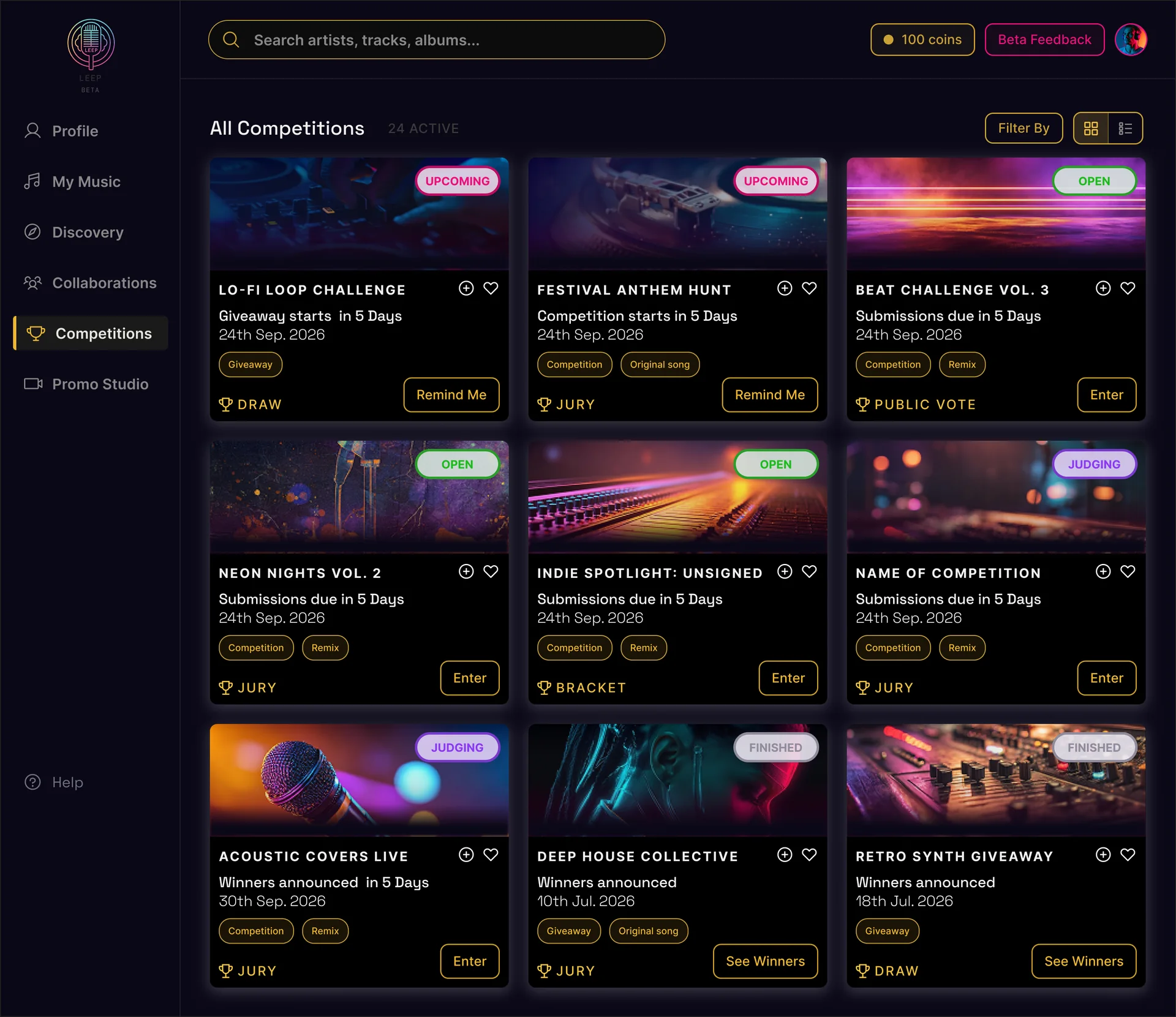
The client asked for one simple name instead of Competition and Contest. On the list, every competition sits under Competitions, and each card says what kind it is.
All competitions live on one grid. Every card carries its status, its format and judging method, and one clear action, before you open it.
One card up close:
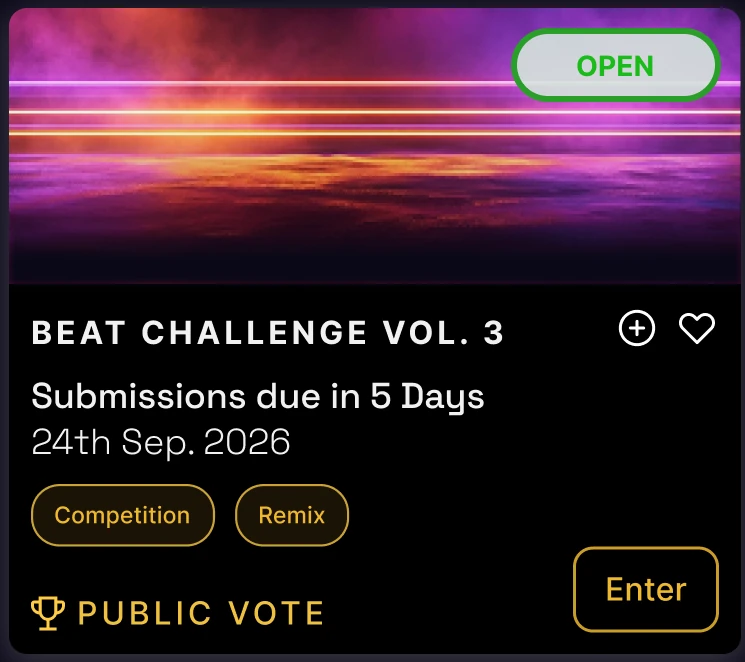
Status first
A coloured label shows Upcoming, Open, Judging or Finished, so you see right away where you can still enter.
Format and judging on the card
Tags say if it is a Competition or a Giveaway, a remix or an original song, and the card says how winners are chosen: Jury, Public vote, Draw or Bracket.
One action per state
The button changes with the status: Remind me, Enter or See winners.
Before you commit, the competition page lays out the format, the prizes and who is already in.
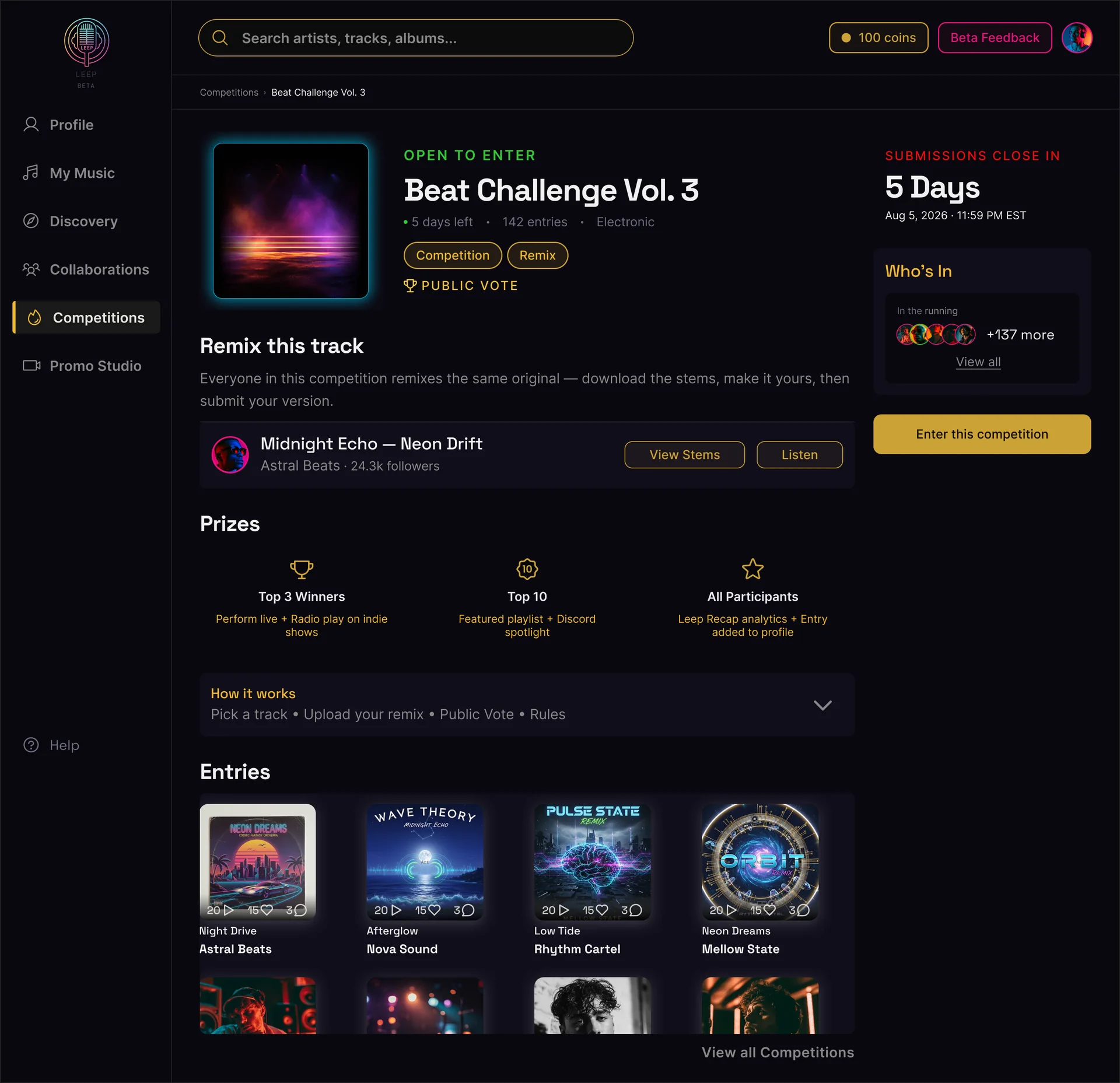
Everything before you commit
The competition page explains what to do ("Everyone in this competition remixes the same original"), shows the prizes for the top 3, the top 10 and all participants, and shows who is already in.
Winners first, then your own result
When a competition ends, every entrant lands on the same page. The top shows the competition and the winners. Below comes your own result, then a way into the next one.
The results page for an artist who placed ninth: winners first, then her own Leep Playback.
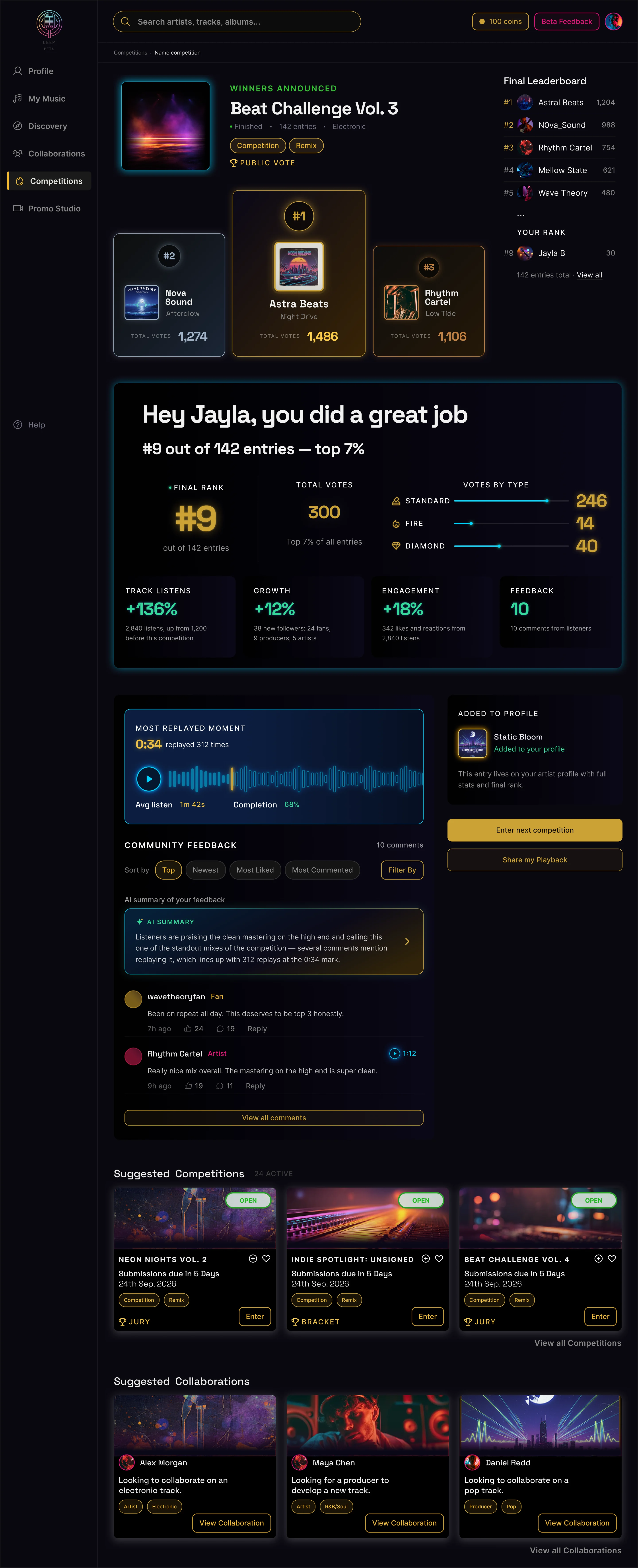
Your rank as a share
"#9 out of 142 entries" reads like a loss. "Top 7%" says the same thing and can feel more like progress, so the page shows both.
The stats people asked for
Track listens, new followers, engagement and feedback, each compared with the artist's usual numbers. These were the stats the survey ranked highest.
Votes that explain themselves
Leep has three kinds of votes. The page shows each one with its icon and count, so a number means something.
The most replayed moment
A waveform marks the part of the track people played again, with the average listen and the completion rate. Analytics is what Leep sees as its strongest advantage, and the tester found this stat valuable.
A summary of the comments
An AI summary turns the comments into what listeners liked and what to improve, so an artist with dozens of comments can read the main points first. Review summaries on Amazon, DoorDash and GetYourGuide were my reference.
A way back in
Enter the next competition, share your Playback, and see suggested competitions and collaborations from the same community.
Artists who did not enter see the same page without the personal part.
One tester and eight survey answers backed the results page
I ran one moderated session, in German, on the work-in-progress prototype. The tester looked for a competition, read the competition page and went through the results page. I used the session to test usability and a survey to check what artists want to see.
What worked
What needed work
What artists want to see after a competition
The Playback stats came partly from the earlier teams, so I ran a pilot survey to check them. 8 people answered: 5 musicians and 3 non-musicians.
"Did people listen till the end?"
Survey respondent
The structure of the results page held up.
The test and the survey led to the changes described next: a list that is easier to scan, a clearer remix explanation, Playback limited to the stats people asked for, and suggestions that lead to other artists.
Four changes after testing and team feedback
Two pages became one
- 1The winners and the personal Playback were two separate pages.
- The earlier Recap was a page of its own.
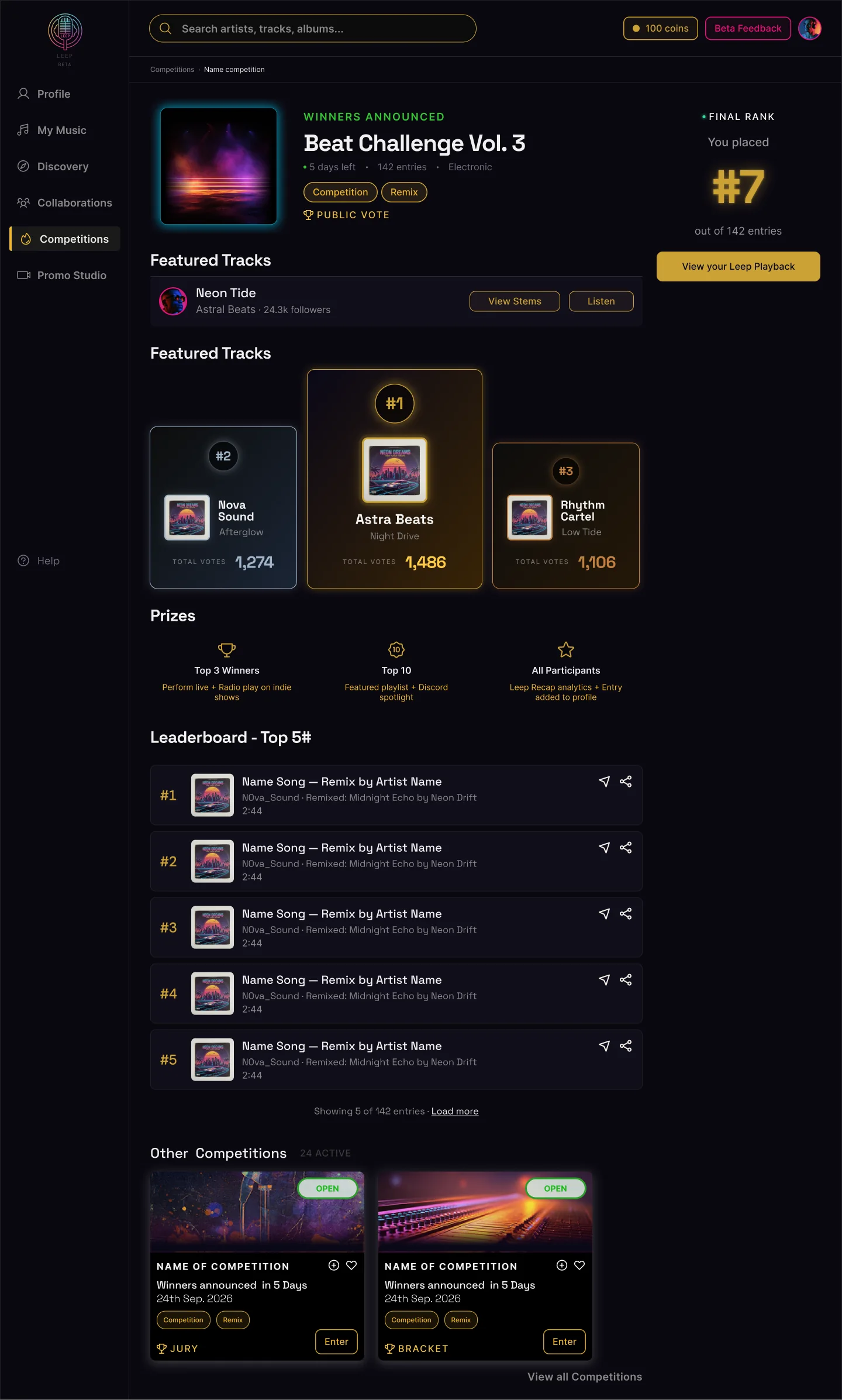
- 1At the team stand-up, the feedback was to merge them. The winners stay on top and your rank also appears in the final leaderboard, so you see yourself next to the top five.
- The tester mentioned that her own rank could come first, but she said she would not really change the order, so the winners stayed on top.
Keeping the stats people asked for
- 1The earlier Recap showed percentile and completion bars.
- 2It also showed coins earned, profile visits and a growth streak.
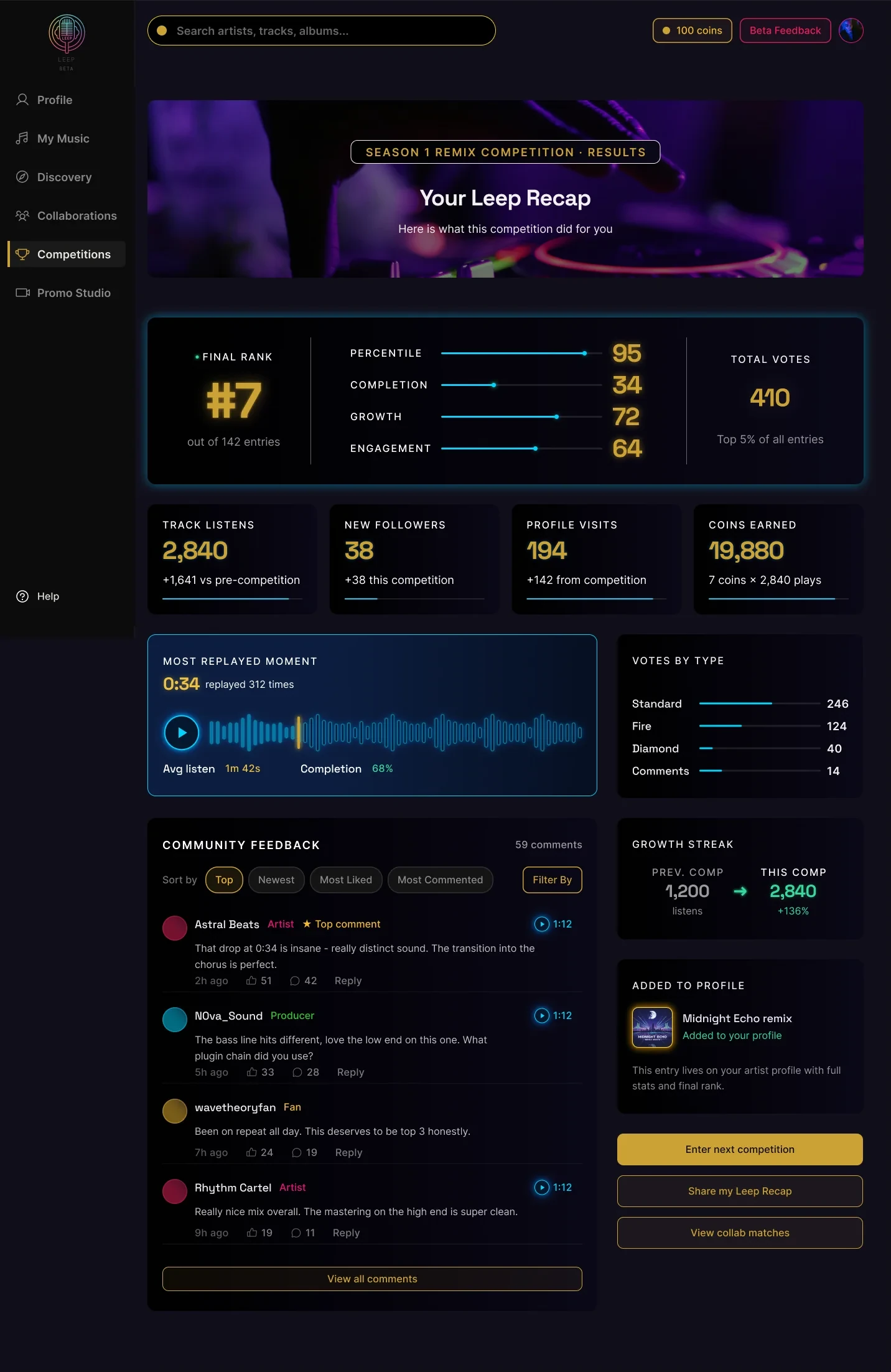
- 1Playback keeps listens, new followers, engagement, feedback and the votes by type. These were close to what the survey ranked highest.
- The percentile bars, coins earned, profile visits and the growth streak are gone.
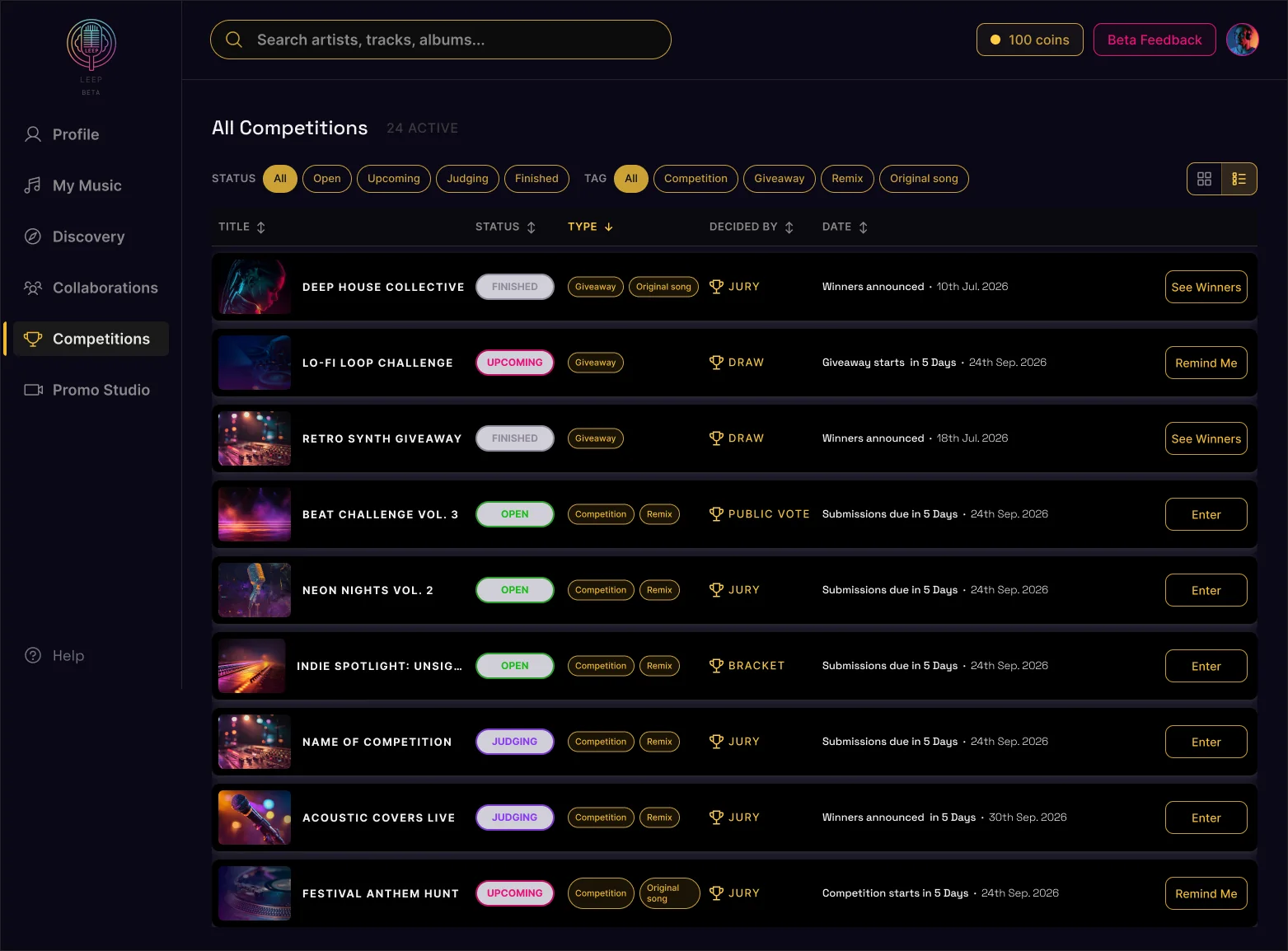
A list you can scan
- A grid of cards in date order, with a filter, and no way to switch views.
- I used Figma Make to explore a list view next to the grid, with a filter bar and compact dates, keeping all the information from the cards.
Saying what a remix contest asks
- 1The tester thought all artists work on one shared track.
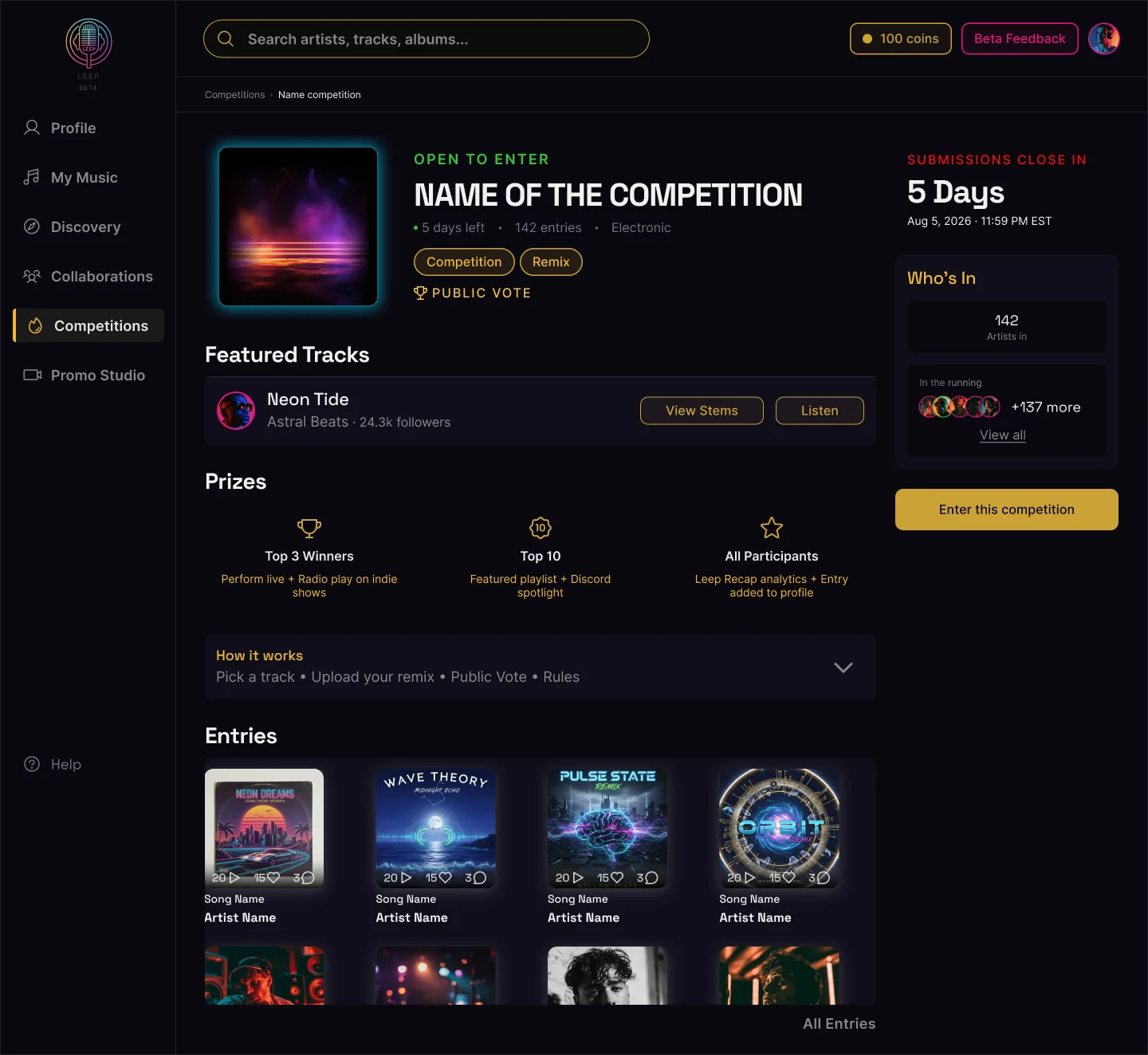
- 1After the test, the page says it in one line: "Everyone in this competition remixes the same original, download the stems, make it yours, then submit your version."
I also tried a bracket page in Figma Make, as an early idea for a later format.
A loss is also something to design
Most people who enter a competition will not win, so what they see after the result could decide whether they come back. That is why most of my original work went into the results page.
Several decisions belonged to Leep and stayed open: how winners are chosen in each format, what the bracket format should look like end to end, and whether artists can listen to other entries while a competition is still running. Listening can inspire people, and it can also help late entrants. I left it as a business decision in my recommendation.
In the final presentation, Leep was very happy with the work. They liked how the design handled the different competition types and Playback. They valued the survey and the validation behind the idea, and that the results page connects to other parts of the platform by suggesting other competitions and collaborations, a reason to stay.
I learned to work with decisions that are still open: when answers took time, I kept going with assumptions and wrote them down as questions for the client. Going deep on two moments gave me more than covering every format a little. One session was a thin base for testing, so next time I would recruit artists early through Leep's own community.
These are future metrics, not results measured during this project.
Re-entry after a loss
How many artists who did not win enter another competition
Playback views
How many entrants open their results
Connections
Follows and messages between entrants after a competition
Entries per competition
Whether competitions grow over time
How I used AI
Claude helped me organise my meeting notes and research, and check my 8 high-fidelity screens against the research instead of judging them by eye. Figma Make helped me explore interactive views, the list view and the bracket page, from my own design direction. The research, decisions and design work are my own.